
Thank you so much for listening to LIFEOLOGY®. I’d love to connect with you! You can find me on all social media platforms under the name JamesMillerLIFEOLOGY®. I’m especially active on Instagram, where I share short videos packed with quick tips and practical tools you can use right away. Be sure to follow and say hello!
Watch the interview
Notable Quotes
“Having a dysregulated nervous system is completely normal. The goal is not to have perfect regulation ever.” – Jessica Baum, LMHC
“What was deeply wounded in relationship needs to be re-experienced and disconfirmed in relationship.”
– Jessica Baum, LMHC“The number one ingredient for security is not love. Our parents can absolutely love us, and that does not mean we are going to have a secure attachment.” – Jessica Baum, LMHC
“Healing attachment wounds requires you to be in relationship.” – Jessica Baum, LMHC
“We are never just one attachment style. Hardly ever does anyone fit into just one.” – Jessica Baum, LMHC
“It doesn’t matter what education you have. We all experience it.” – James Miller, LPC
“People can express themselves however they want, but when they use logic, sometimes that’s actually a form of emotion as well.” – James Miller, LPC
Episode Summary
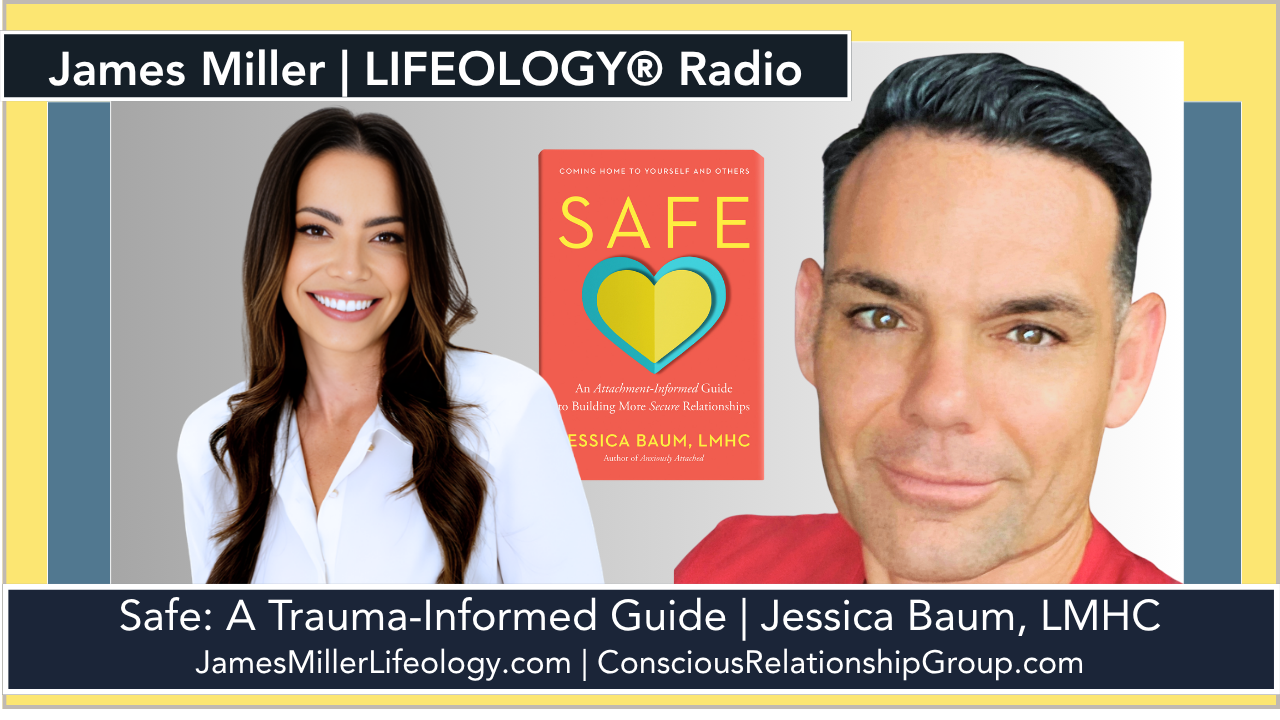
Jessica Baum, LMHC, licensed psychotherapist and author of Safe: Coming Home to Yourself and Others, joins James Miller on LIFEOLOGY® Radio to explore how attachment patterns shape our relationships, nervous system responses, and sense of emotional safety.
Jessica explains how secure, anxious, avoidant, and disorganized attachment patterns develop, why attachment theory is often oversimplified, and how people can begin to earn security even if they did not grow up with it. She also discusses the role of co-regulation, emotional presence, inner protectors, and safe relationships in healing relational wounds.
In this conversation, James and Jessica discuss why dysregulation is not failure, why love alone does not always create secure attachment, and why healing often requires safe connection with others rather than isolation. Jessica also shares insights from Safe, including the Wheel of Attachment, the importance of attunement, and how attachment patterns can show up not only in romantic relationships, but also in family systems, friendships, and the workplace.
About the Book
Safe: An Attachment-Informed Guide to Building More Secure Relationships explores how attachment wounds shape the way people love, connect, and protect themselves. Jessica Baum, LMHC goes beyond attachment labels to show how people can build earned security through self-awareness, co-regulation, emotional presence, and safe relationships
Drawing from trauma-informed care, interpersonal neurobiology, and somatic practices, Safe helps readers understand their protective patterns, reconnect with the parts of themselves that long for safety, and move toward relationships that feel calm, connected, and real.
Episode Transcript
Click to read the episode transcript
Transcript
James Miller, LPC:
My guest today is Jessica Baum, who is the owner and founder of the Be Self-full Method and The Relationship Institute of Palm Beach, Florida. Jessica is a licensed psychotherapist who is certified in many counseling methodologies that help transform the lives of her clients. Through Be Self-full, Jessica offers coaching services that support individuals and couples in forming healthy, long-term relationships.
In today’s episode, we talk about her book, Safe: An Attachment-Informed Guide to Building More Secure Relationships. This book moves beyond the basics of attachment theory and into the heart of what truly drives our relationship patterns.
For more information about Jessica and her work, visit ConsciousRelationshipsGroup.com. Welcome to LIFEOLOGY®.
Jessica Baum, LMHC:
Thank you for having me.
James Miller, LPC:
I am looking forward to this. You were on my show years ago when you talked about your first book, Anxiously Attached, and I’ve used it so many times with my clients. In fact, I’ve read it as well, obviously, but it was something that really impacted me too. So I’m really glad to be able to talk about your second book, Safe.
Jessica Baum, LMHC:
Yeah, glad to be here years later.
James Miller, LPC:
We look the same though.
With attachment theory, what was it about that specifically drew you to that methodology and that theory?
Jessica Baum, LMHC:
Well, in Anxiously Attached, I talk about being in the hospital and suffering from anxiety and panic attacks. I remember grabbing Facing Codependency, and I was like, “Oh my God, I finally have words for what I’m experiencing.” It helped me feel a lot less crazy, and it kind of started my path toward healing.
Later, when I started to study interpersonal neurobiology and understand attachment on a deeper level, I realized that every “codependent,” quote-unquote poorly coined word, was really talking about attachment theory underneath it.
When you really start to understand attachment theory, it is such a deeper, more fulfilling explanation of our behavior patterns. I was like, “Well, I needed it, so I’m sure the world needs it.” That was the birth of Anxiously Attached, which has done phenomenally in the world.
Then Safe came later, which is a deeper dive into all attachment styles and how to heal attachment wounds. It goes even deeper.
James Miller, LPC:
Before you were in your schooling, had you learned this before? Did you read this information before, or did you read it after your schooling?
Jessica Baum, LMHC:
I definitely did all my trainings and learning after school. My mentor, who I credit in Safe, and who helped me with Anxiously Attached, is Bonnie Badenoch. She has studied interpersonal neurobiology for a couple decades and wrote The Heart of Trauma and a couple other books.
I’ve had a lot of really great mentors and trainings post-graduation.
James Miller, LPC:
I find that for myself too. I went through the schooling as well, and years later is when I really could assimilate all the information. I’m like, “Oh my gosh, now this makes sense.” I can see the full patterns. I can see the full scope of it.
Obviously, when we’re learning in the moment, we’re so focused on something that we don’t really see how it affects us as a person as well.
Jessica Baum, LMHC:
Yeah, I just learned so much more. That was my journey.
James Miller, LPC:
There are four different types of attachment. Do you want to explain what those are?
Jessica Baum, LMHC:
Sure. There’s secure attachment. Secure people who have a lot of security walk around the world with fewer abandonment wounds. They have the felt sense that their needs are going to get met. They’re okay with space. They’re okay with getting close. They tend to do transitions pretty well.
They grew up in a home where their parents were pretty attuned to them, so they felt like their parents were present and their needs were essentially going to get met.
Then there are three insecure types.
There’s anxious attachment. An anxious pattern is when the baby senses that the mom is there sometimes and sometimes not. So energetically, the baby leaves and co-regulates. The baby takes care of mom. Self-abandonment is at the core of anxious attachment. They can also feel what other people need faster. They can read the room. It includes everything you would see on a quote-unquote list of codependent traits.
Then the other end of the extreme is avoidant attachment. A true avoidant baby didn’t have emotionally available parents. A lot of this gets tricky because many avoidant people are not even aware that they didn’t have emotional availability. That baby learns, “Why even raise your hand? Why reach out? I’m going to do this on my own. I’m going to be self-sufficient and independent.” Vulnerability and co-regulation are very hard for that baby.
Then there’s disorganized attachment, which, in layman’s terms, is fearful avoidant. That is when a baby gets stuck in, “I need my parents so badly, but they’re terrifying.” Either they’re stuck in anger, rage, or neglect. So there is this need to connect, but then they can’t connect. They’re kind of stuck in this terrified state.
In Safe, I talk about the wheel of attachment, with security on the bottom, disorganized on the top, anxious and avoidant on the sides. You move on the wheel. It becomes a more holistic understanding of how attachment lives in your system.
James Miller, LPC:
Do people have the same attachment style across the board, or is it different in each relationship?
Jessica Baum, LMHC:
Different relationships. You can be playing out your attachment patterns, but how I might play them out in my romantic life might be different than how I play them out in my work life.
My attachment system is also going to resonate or dance with your attachment system. So if I’m in relationship with you, James, it’s our embedded patterns and how they start to work together within the system. It’s very nuanced.
I’m so grateful that out in society, everybody has so much awareness. The book Attached got everything out there. But I feel like attachment theory has been oversimplified, and people don’t fully understand it. That’s why I wrote Safe, to really get into the nuance and help people understand the bigger picture around attachment.
James Miller, LPC:
I spoke about this in our previous interview. I am usually very happy. I like to think I have a very secure attachment. But the last relationship I was in, I found myself in this really anxious, insecure attachment, and I was so surprised because I had never experienced that type of panic before.
It was an experience for me. So as a person experiencing it, I can speak about that firsthand. In that relationship, unfortunately, it ended, but that person had more of an avoidant style. The dance back and forth was something that I had never truly experienced before.
It doesn’t matter what education you have. We all experience it.
Can you debunk some of the myths that people have regarding co-regulation, the nervous system, or attachment overall?
Jessica Baum, LMHC:
We are never just one attachment style. Hardly ever does anyone fit into just one.
We need each other. We’re fundamentally wired to be dependent, vulnerable, and interdependent on each other. Healing attachment wounds requires you to be in relationship.
James Miller, LPC:
Interesting.
Jessica Baum, LMHC:
All of Safe talks about how you need a safe nervous system in order to regress and heal your deeper wounds.
James Miller, LPC:
What about the nervous system? Is there anything you could debunk about that?
Jessica Baum, LMHC:
When you say debunk, do you have something that you want me to debunk?
James Miller, LPC:
No. I just hear that quite often. People say, “My nervous system is dysregulated.”
Jessica Baum, LMHC:
Having a dysregulated nervous system is completely normal. The goal is not to have perfect regulation ever.
James Miller, LPC:
Yes.
Jessica Baum, LMHC:
The goal is to get back into homeostasis faster as you heal. You build a bigger window of tolerance and capacity to get back into your baseline.
I’m so upset with the way online culture is pushing, “You need to have a perfectly regulated nervous system.” No, that’s not the picture of health. Thank God we have a nervous system that dysregulates. We need to pay attention to it.
There’s nothing wrong with you if you get dysregulated. It’s important information. It’s where healing happens. Without any dysregulation, that’s not the goal. That is not how we are wired.
We are constantly fluctuating between states every second, every nanosecond. We combine states. If we’re having sex, we’re not just in safety. We might be in a little sympathetic activation. If we’re playing, we might be in another combination of states.
People are minimizing it, and they’re also shaming you if you’re not living in a regulated state.
Doing the work means being in the presence of others who are in regulated states so you can dive deep into your regressed parts. Eventually, that expands your ability to be in more regulated states. You don’t stay in those states. You vacillate, and that is part of being human.
James Miller, LPC:
When you say you have to be in a relationship to heal, could that also be a relationship with yourself, or does it have to be a relationship with other people?
Jessica Baum, LMHC:
It has to be a relationship with other people.
What was deeply wounded in relationship needs to be re-experienced and disconfirmed in relationship. If you have early relational wounds, you can’t heal those wounds only alone. Those wounds were created because you were in relationship with someone who either didn’t show up or didn’t show up in the way that you needed.
You need to meet those wounds and receive what you didn’t get at the time. That requires another nervous system.
James Miller, LPC:
For the people who are hearing this and thinking, “Oh my gosh, I never want to date again. I never want to love again,” what would you say to them?
Jessica Baum, LMHC:
I would say, honor that right now. I’m not asking you to love again. There’s a protector there. It’s there for a really good reason. Let’s figure out and be with why it makes sense that you don’t want to love again right now.
James Miller, LPC:
That’s why you’re so good at this.
Looking at your book Safe, I was looking through the different chapters and different things you have, which I found quite fascinating.
The first part is searching for safety: the power of connection, finding your anchor, and welcoming your inner protectors.
The second part is coming home to our bodies: the eternally present past, healing our younger selves, and healing the patterns that keep us stuck.
Part three is living in heartfelt connections: knowing when to stay and when it’s time to go, what happens when we heal, and reaching your safe harbor.
Thinking about all those things, how were you able to compartmentalize and separate each of those? There is so much depth in each one of those chapters.
Jessica Baum, LMHC:
It’s funny. I’m not the best writer. I can say a lot of things about myself, but I am really good at conceptualizing the big picture, which is kind of a right-brain thing.
Anxiously Attached and Safe are laid out in the sense that I give you information in the beginning. Then the middle of the book is the somatic work. You go into the body. We talk about memory. We have meditations. Then the last part of the book is integrating that and bringing you into your current world.
There’s a formula to my two books. I don’t know if my third book will follow the same formula, but the meat of the book is in the middle. You want to go through the whole journey.
It was fairly easy for me to come up with that. I just did a brief outline for a book that I’m working on with someone else, actually. I sat down and was able to conceptualize the whole thing. Maybe I’m just good at seeing that. I’m not good at everything in terms of writing a book, but I am really good at putting the whole picture together.
James Miller, LPC:
When I was reading this, one part that really stuck out to me was something that many people don’t really know about. You talk about welcoming your inner protectors. What does that mean?
Jessica Baum, LMHC:
Like you said, the person who never wants to date again. That is a part of them that is protecting them from being hurt.
A protector can also be, “I’m feeling overwhelmed, so I’m going to drink some alcohol. I don’t want to be with my feelings. I’m going to run 16 miles right now.”
Protectors are things that we need or do compulsively in order to avoid what is going on inside. So many of us who didn’t have parents or people to hold space and regulate with us developed other ways to manage our world.
Sometimes the protectors are really annoying. If you have an eating disorder, it’s a really annoying protector. But those protectors showed up when they showed up because they were trying to help you or help you cope with something you weren’t able to cope with.
It’s not that every time you have a glass of wine, it’s a protector. It’s when I’m feeling a particular way, and I don’t know how to manage it, so I do this behavior. It protects me and helps me manage my inner world.
We all have protectors, and we actually need our protectors. So when a person says, “I don’t want to do it again. I never want to fall in love,” that’s a protector. Honoring that protector and why that protector is here is so much more important than shaming yourself or trying to get rid of it.
James Miller, LPC:
In my book, I talk about how our self-soothing behaviors all come from our five senses. When we’re kids, we have our sense of sight. We can see our caregiver. We can see a mobile above our crib. The sense of taste can be milk or a pacifier.
As we get older, we often don’t mature those self-soothing behaviors that made sense for us as a kid. As adults, we often regress back to the senses that made sense when we were younger.
If someone overeats, and we’re talking about an eating disorder, maybe when they were younger, they needed to overeat. Now, when they’re older, they haven’t developed that part. They find themselves back in a part of themselves that is more underdeveloped.
In some ways, I can see how that would make sense with protectors. That’s what made sense for us, and that’s what kept us safe when we were younger. Now we get a chance to develop that, look at it, and see whether it makes sense with our current age today.
Jessica Baum, LMHC:
Yeah, and what was it keeping us safe from? That’s where we want to go. Get underneath the behavior.
James Miller, LPC:
Exactly.
One thing I want to clarify as well is when people say, “Well, I had a great childhood.” Can you explain the difference between having a wonderful childhood and still having attachment wounds?
Jessica Baum, LMHC:
Yeah. This happens so many times, and if you’re listening, I totally get it.
The number one ingredient for security is not love. Our parents can absolutely love us, and that does not mean we are going to have a secure attachment.
The number one ingredient to build secure attachment is emotional presence. You need attunement. You need emotional presence. You need your needs met.
Many parents in our world, especially in Western culture, are in sympathetic activation. They’re in hustle culture. They’re not present. They’re not slowed down. But they love their kids, and they’re good parents.
They just weren’t there enough in a state of safety, in their ventral nervous system, to help us internalize enough security. So we grow up feeling a little less secure in the world.
A lot has to do with internalizing our parents and where their nervous systems are. We’re passing down our nervous system.
A lot of people who grew up with parents who were more avoidant, and I am one of them, have one of the biggest protectors, which is, “I had a fine childhood, but I don’t remember it.”
James Miller, LPC:
Interesting.
Jessica Baum, LMHC:
They’re not in touch with the agonizing grief of not having emotional attunement because they haven’t experienced it.
When they’re in session with me or with an anchor, and they’re starting to get attunement, we start to go there together. At some point, I can say, “And you didn’t get any of this.” Then we start to open the door to what they didn’t receive.
That’s a whole process. A lot of people are in that bracket. I was actually in that bracket. You don’t realize how much you didn’t receive until you start to receive it. Then you’re like, “Oh wow, I really did need this kind of holding when I was a kid. This feels different.”
I had a client today who is a new client. I was attuning, holding, and seeing her. She said, “I’ve been telling my husband and all my friends, this is all I want. And when I receive it, it’s the most uncomfortable feeling in the whole world.”
That’s because she never received it. We desire it, and then when we have it, it’s really uncomfortable. It leads to vulnerability and being with more of ourselves.
James Miller, LPC:
And when people experience that vulnerability, they usually pull back as well, don’t you think?
Jessica Baum, LMHC:
Yeah. You can pull back, or I must go really slow with her so I don’t flood her.
James Miller, LPC:
I’m saying when she experiences that discomfort, will people typically pull back?
Jessica Baum, LMHC:
Sometimes. Pulling back could be getting more analytical. Pulling back can look like a lot of different things. And pulling back is allowed. It’s like putting a toe in the water.
James Miller, LPC:
I tell people that even though people can become very logical, I like to think of logic also as a form of emotion. People can express themselves however they want, but when they use logic, sometimes that’s actually a form of emotion as well. Like you said, it’s a version of keeping themselves safe.
I wanted to ask about the different generational aspects. If someone has a parent who, like yourself, may have been avoidant, how does that affect them, and how does it affect their children?
Jessica Baum, LMHC:
Avoidance is big in our culture, too, and it’s only growing. Avoidance really lives in the left hemisphere.
Avoidance is when a parent can’t emotionally attune and connect a lot, and they’re more task-oriented. With the baby, the baby learns not to look at their needs. That child grows up more independent, with less ability to co-regulate, less ability to do vulnerability, and less emotional IQ.
If you have less emotional IQ, you can’t give more emotional IQ. There’s an intergenerational piece. Unless you stop and do the work to develop what you didn’t receive, we pass it down intergenerationally.
There are epigenetic and other biological things that get passed down as well, but nervous system presence and the ability to be present with our children is something we can do if someone was present enough with us.
James Miller, LPC:
Exactly. I’m working with some people right now who are experiencing that. Their mother is very avoidant, and it’s affecting them as children in the family system, as well as how they parent their own children.
Many people don’t realize how attachment theory can affect multiple generations. People like you are really helping people understand that change is possible. It doesn’t have to be that way. There’s a different way to live and a different way to experience safety.
Jessica Baum, LMHC:
Yeah. If you’re listening, sometimes when you start to experience safety in a relationship, I call them anchors. Real, present, available people can actually feel really uncomfortable.
James Miller, LPC:
Earlier, we said that love doesn’t necessarily mean secure, but safety does. That may be difficult for some people to understand. When you say safe, what does that typically mean?
Jessica Baum, LMHC:
In Safe, I talk about safety through the nervous system.
When we feel safe in our highest evolved state, we’re in a ventral state of connection. Our social engagement system is on. You and I are pretty much in that ventral state right now. I’m sure we dip a little into sympathetic because we’re recording, but when we’re in a ventral state of connection, my whole being is open. My voice is different. My eye contact is different. My body is saying to you, James, “It is safe to come here. It is safe to talk to me. We are safe together.”
When we can be in these states of enough safety, we’re cueing to another person, “Be open with me. Come join with me. Be with me.”
When we have a baby with us and we don’t feel safe, maybe there’s a war, or we are hustling, or our partner is yelling at us, and we’re constantly dysregulated, that baby picks up on, “Wow, mom’s not there. She’s anxious. She’s busy. She’s not regulated enough for me to sense that presence and internalize her being with me.”
That’s what babies do. We internalize our primary caregivers, for better or worse. We internalize people throughout our lives through mirror neurons and resonance circuits. We take people in.
If our parent is relatively safe and anchored in their ventral system a lot, and they’re attuning to us, we’re going to internalize that. Those are the babies who leave the room and don’t have to look behind their shoulder too much because they have that felt sense of safety within.
When an anxious baby leaves the room, they have to turn around and continuously check, “Is mom still there?” because they haven’t internalized it.
An avoidant person leaves the room and might never check again. They’re off. They’re disconnected.
All of this happens, and we know through attachment theory that this happens. But it also happens in our adult relationships. This gets replayed out. I think that’s what everybody is so fascinated by. It’s like, “Oh my God, this stuff is really happening in my adult world.”
Learning about it is the beginning for a lot of people. It helps them put the pieces together and begin a journey of healing and making sense of their own story and behaviors. That in itself is very healing.
James Miller, LPC:
I’ve noticed some people I’ve worked with where the mother is aware that she wasn’t as present as she could have been. With that, there’s a lot of pain that she experiences. What would you say to the parent who has this recognition or awareness and wants to reconnect with their adult child?
Jessica Baum, LMHC:
I think we can only do the best with what we were given, so don’t be too hard on yourself.
If you do the work now, you can show up for your child and repair what the child didn’t get. There’s always rupture and repair. There’s always repair.
The repair might sound like, “You know what? I was pretty inconsistent,” or, “I didn’t show up really well.” That might be deep repair work. It might not be just one sitting.
But that child or adult hearing that, once you’ve done some of your own work, and having their experience validated, is part of how they begin their healing process. So it’s never too late to repair.
James Miller, LPC:
I agree. What would you say to individuals who maybe had no awareness and are now realizing that something is off in their relationships? What are ways for people to understand that they are having some dysregulation and may just not be aware of it?
Jessica Baum, LMHC:
Dysregulation can feel like fight, flight, freeze, stomach aches, chest tightening, racing thoughts, not feeling safe in the world, using lots of medicators because you don’t feel regulated.
Your body signals it through a lot of visceral responses that are fear-based. Any kind of fear state living in your body, even just tightness in your chest, queasiness in your stomach, tense muscles, or your jaw always being clenched, can be signs that your body is stuck in some kind of survival state.
James Miller, LPC:
One last question. When it comes to our place of employment, what happens if my boss, or someone who has a higher level than myself, has an avoidant attachment style? How would I deal with something like that when it’s not about a romantic relationship, but it is about a work relationship?
Jessica Baum, LMHC:
Safe covers everything. Any close relationship does not have to be romantic.
For me, attachment played out mostly in my romantic relationships, but it plays out in every close relationship that is meaningful. You’re going to have attachment patterns.
Someone listening might say, “Oh, I don’t have any issues with my boyfriend or girlfriend, but my sister, my mother, or my boss activates me.” That’s okay. Depending on our childhood and many other factors, work is where attachment shows up the most for many people.
You know how many people I am the critical parent for who work for me? I have to work through all of that. So much gets projected onto these power dynamics at work. It’s constantly happening.
James Miller, LPC:
What is the main thing you want people who read your book Safe to take away?
Jessica Baum, LMHC:
I hope they get the information they need. I hope they can feel that I am with them. I hope they have a better understanding of attachment theory and the wheel of attachment. And I hope they reach out to me if it resonates.
The information is so important. I just want them to have it.
James Miller, LPC:
Jessica Baum, thank you so much. You’ve been an absolutely perfect guest on my show.
If my viewers and listeners want to find more information about you and purchase your book Safe, where can they find everything online?
Jessica Baum, LMHC:
Safe is everywhere. You can go to Amazon. You can go anywhere and get Safe. Just look up Safe: An Attachment-Informed Guide, or Safe Jessica Baum.
I’m on Instagram at Jessica Baum, LMHC. I try to respond to everybody who reaches out about the book. I have someone who helps me with content, but I personally try to respond to people who reach out about the book. If you reach out to me, I’m going to do my best to respond to you. Please do.
James Miller, LPC:
Wonderful. My viewers and listeners should also know that if they can’t find this information any other place, simply go to the show notes at JamesMillerLifeology.com, and I’ll have all the information there as well.
Jessica, thank you so much for your time today.
Jessica Baum, LMHC:
Thank you so much, James. This was great.
Jessica Baum, LMHC
Jessica Baum, LMHC, is a licensed psychotherapist whose journey began with a lifelong curiosity about the “whys” of life: why we feel, connect, and experience the world the way we do. This passion led her to specialize in trauma, attachment theory, and interpersonal neurobiology.
Jessica believes that connection to ourselves and others is at the heart of healing, and she uses a range of modalities to help individuals and couples return to wholeness. She is the founder of the Relationship Institute of Palm Beach, a private group practice, and she leads the Conscious Relationship Group, a global coaching company offering support to clients worldwide.
Jessica is a certified addiction specialist and Imago couples therapist with advanced training in EMDR, experiential therapy, CBT, and DBT.
Connect with Jessica Baum, LMHC
Instagram: @jessicabaum.mhc
website: consciousrelationshipgroup.com
Purchase the book on Amazon or at your preferred bookstore
James’ book, LIFE LESSONS: You Are the Expert of Your Life | A Workbook, is your new go-to guide for real-world clarity—when you need it most.
Purchase it on Amazon today.
We’ve all had those moments—when life gets loud, emotions run high, and clarity slips through our fingers. LIFE LESSONS is the book you reach for in those moments.
This isn’t a book that tells you what to think. It’s a guide that helps you remember what you already know. Whether you flip to a single chapter or read it cover to cover, each section is designed to reconnect you with the parts of yourself that have worked before—those steady inner tools you may have forgotten during the chaos.
You don’t need to reinvent your life from scratch. You’ve already lived enough to know what works. This book simply helps you recognize it, refine it, and return to it with purpose.
If you’re ready to stop repeating the same patterns, want practical tools to reset when life throws a curveball, and are finally willing to trust that you are the expert on your life, this workbook was written for you.
Don’t miss anything happening at James Miller | LIFEOLOGY®. Sign up for the free Weekly Recap. You may also subscribe to this radio show here.
If you’d like to become a guest or a show sponsor, please visit JamesMillerLIFEOLOGY.com/guest for more information.