
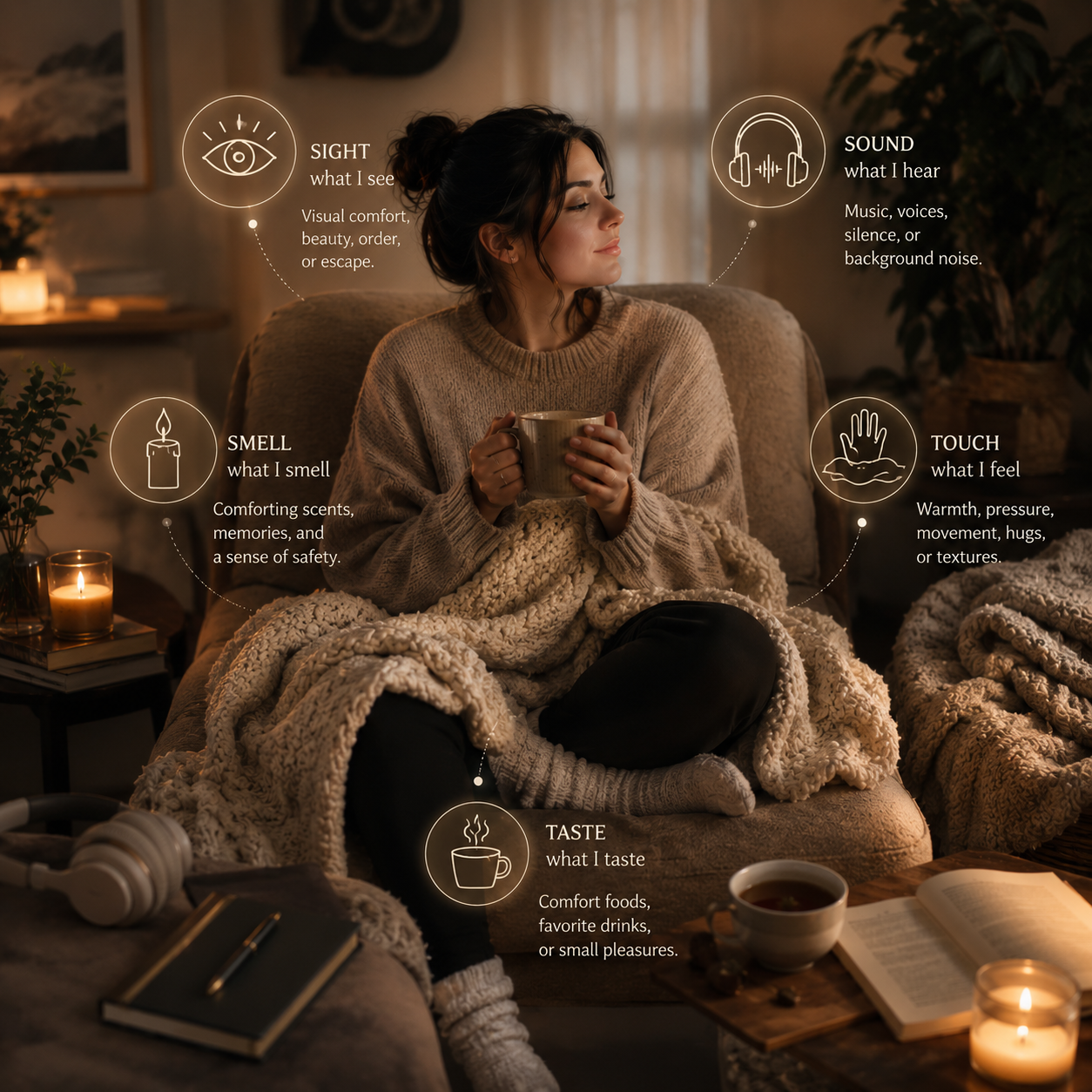
Most people self-soothe every day without realizing they are doing it.
Self-soothing is not automatically a bad thing. In fact, it is one of the ways we learn to take care of ourselves. When we feel overwhelmed, bored, restless, disconnected, sad, lonely, anxious, or emotionally flat, we often look for ways to change how we feel.
Sometimes we are trying to calm ourselves down. Sometimes we are trying to wake ourselves up. Sometimes we are trying to feel connected. Sometimes we are trying to feel in control. Sometimes we are simply trying to feel something different than what we are currently feeling.
The important question is not, “Why am I doing this bad thing?” The better question is, “What is this behavior helping me feel, avoid, change, or create?”
That question removes judgment and invites understanding.
How We Learn to Self-Soothe
As children, we learn how to regulate ourselves through our senses. Touch, sight, sound, taste, and smell all become ways that we experience comfort, safety, stimulation, connection, and relief.
A child may be soothed by being held. Another child may feel calmer when watching a caregiver move around the room. Another may feel comforted by a familiar voice, a favorite food, or the smell of a blanket, home, or someone they love.
Over time, many people develop a primary sensory pathway for self-regulation. This does not mean they never use the other senses. It means one pathway often becomes the main way their nervous system learned how to shift emotional states.
That pathway may have worked very well in childhood. It may have helped the child feel safe, calm, seen, entertained, stimulated, or connected.
The problem is not that the pathway existed.
The problem occurs when the adult continues relying on that same pathway automatically, without realizing it, and without asking whether that behavior is still the healthiest version of regulation for who they are now.
The behavior may change over time, but the function often stays the same.
A child who used taste for comfort may become an adult who uses food, alcohol, smoking, or oral stimulation to regulate.
A child who used sight for comfort or stimulation may become an adult who turns to television, social media, video games, pornography, shopping, or visual novelty.
A child who used sound to regulate may become an adult who needs music, podcasts, background noise, constant conversation, reassurance, or even conflict.
The adult behavior may look different, but it may still be serving the same purpose: “I am trying to change how I feel.”
Self-Soothing Is Not Always About Pain
Many people assume self-soothing only happens when someone feels sad, anxious, lonely, or overwhelmed. That is not always the case.
People also self-soothe when they are bored. They self-soothe when they feel restless. They self-soothe when life feels too ordinary. They self-soothe when they feel emotionally flat. They may even self-soothe when they are happy, excited, or celebrating.
This matters because the behavior is not always about escaping pain. Sometimes it is about creating a desired state.
A person may want more excitement, more pleasure, more comfort, more connection, more intensity, more focus, or more relief.
That is where brain chemistry comes in.
People may not use these exact words, but often they are trying to shift their internal chemistry. They may be trying to experience dopamine, serotonin, oxytocin, adrenaline, endorphins, norepinephrine, or a decrease in cortisol.
In everyday language, that may sound like: “I need something to look forward to.” “I just want to feel better.” “I need to calm down.” “I need to feel connected.” “I want to feel alive.” “I need to take the edge off.” “I’m bored and need something to stimulate me.” “I want to stop thinking for a while.”
The brain remembers what works. If a behavior changes someone’s emotional state, even briefly, the brain stores that behavior as an option. If the person repeats it enough, it can become a habit. If the habit becomes the primary way the person regulates, it can become difficult to interrupt.
That is often how unhealthy habits begin.
Not because the person is weak. Not because the person is bad. Not because the person lacks character.
But because the behavior worked at some point.
The question becomes: Is it still working in a healthy way now?
Examples of Self-Soothing Through the Five Senses
Taste
Taste is one of the most common ways people self-soothe. Food can represent comfort, reward, celebration, control, connection, or relief.
A child may learn that food helps them feel calm, loved, or comforted. As an adult, that person may continue using taste to regulate emotions.
This can show up as eating when bored, eating when lonely, eating when anxious, using food as a reward, craving sugar or salt when stressed, drinking alcohol to relax or feel more social, smoking, vaping, using oral stimulation to settle the nervous system, or late-night snacking as a way to feel comforted before bed.
None of this automatically makes someone “bad” or “out of control.” The behavior has a purpose. The person may be trying to feel comforted, rewarded, soothed, distracted, or emotionally filled.
The question is whether taste is being used in a way that supports the person’s life, body, mood, sleep, relationships, and long-term health.
Sight
Sight can be a powerful regulatory pathway. Some people soothe themselves by watching, observing, scanning, or visually absorbing information.
As children, this may have looked like watching a caregiver, observing the environment, looking for safety cues, watching television, or becoming absorbed in visual stimulation.
As adults, this may show up as watching TV for hours, scrolling social media, playing video games, online shopping, watching pornography, looking for visual novelty, constantly checking messages or notifications, rearranging or controlling one’s environment, or needing visual order to feel calm.
For some people, visual stimulation creates a temporary shift in brain chemistry. A suspenseful show may create adrenaline. A romantic storyline may create connection. A comedy may create relief. A shopping app may create anticipation. A video game may create reward, focus, and achievement.
The person may not be consciously thinking, “I am using sight to regulate.” But that may be exactly what is happening.
Again, the question is not, “Is this wrong?” The question is, “What is this helping me feel, and is this the healthiest way for me to get there today?”
Sound
Sound is another major pathway for self-soothing. Some people regulate through music, conversation, silence, rhythm, tone, or noise.
Healthy uses of sound may include listening to calming music, playing music, singing, listening to a podcast, talking with a trusted person, using white noise to sleep, listening to nature sounds, praying out loud, or repeating affirming statements.
But sound can also become more complicated.
Some people do not only seek calming sound. They may seek intense sound. They may need loud music, loud environments, heated conversations, arguments, or yelling in order to feel regulated.
This can seem paradoxical, but it makes clinical sense.
If someone’s nervous system learned that high-volume emotion creates stimulation, adrenaline, focus, release, or even connection, they may unconsciously recreate environments where that same sound pattern occurs.
They may provoke conflict. They may become adversarial. They may place themselves around people who yell. They may escalate a conversation without realizing why. They may feel strangely relieved after an argument.
This does not mean they want to be hurt. It does not mean they enjoy chaos in a simple way. It may mean their nervous system has learned to use intensity as a form of regulation.
For some people, calm feels unfamiliar. Quiet feels empty. Peace feels boring. Conflict, volume, and emotional intensity create a container their nervous system recognizes.
The problem is that this kind of self-soothing can damage relationships and reinforce painful patterns.
The goal is not to shame the person. The goal is to help them recognize the pattern and ask, “Am I creating intensity because I do not know how to regulate without it?”
Touch
Touch can also become a primary pathway for regulation. As children, many people are soothed through holding, rocking, hugs, blankets, pets, movement, or physical closeness.
As adults, touch-based self-soothing may show up as wanting hugs or physical affection, using weighted blankets, taking hot showers or baths, exercising, stretching, massage, skin care routines, holding a pet, wrapping oneself in blankets, seeking physical intimacy, fidgeting, tapping, rubbing, picking, or repetitive movement.
Some of these behaviors may be very healthy and grounding. Others can become unhealthy depending on intensity, context, or consequence.
For example, exercise can be a healthy way to regulate stress. But if someone uses exercise compulsively, ignores injury, or feels emotionally unsafe when they cannot work out, then the same pathway may no longer be serving them in the healthiest way.
Physical intimacy can be a beautiful way to experience connection. But if someone uses touch or sex primarily to avoid loneliness, feel temporarily wanted, or regulate abandonment fears, the behavior may leave them feeling worse afterward.
Skin picking, nail biting, hair pulling, or constant fidgeting may also be attempts to regulate through touch. The body is trying to discharge, focus, soothe, or interrupt discomfort.
The behavior is communicating something.
The goal is to listen before judging.
Smell
Smell is often overlooked, but it can be deeply tied to memory, comfort, safety, and emotional state.
A person may be soothed by familiar smells from childhood, a caregiver’s scent, clean laundry, certain foods, candles, perfume, cologne, nature, or home.
As adults, smell-based regulation may show up as lighting candles, using essential oils, wearing a familiar perfume or cologne, smelling blankets, clothing, or pillows, cooking familiar foods, wanting the house to smell clean, using incense, seeking the smell of nature, rain, wood, flowers, or the ocean, or avoiding places that smell unsafe, dirty, medical, or emotionally loaded.
Smell can also be connected to grief, attachment, and memory. A person may smell something and immediately feel transported to another time in life. This can be comforting, painful, or both.
There can also be unhealthy expressions of this pathway. Someone may become rigid about smells in the home, overly distressed by certain scents, or use substances with strong smells as part of a ritualized behavior. The smell itself may become part of the emotional loop.
Again, the question is not whether the sense is good or bad. The question is what emotional state the person is trying to create or avoid.
When Self-Soothing Becomes a Habit
A self-soothing behavior becomes more concerning when it becomes automatic, excessive, harmful, or uncontained.
There is nothing wrong with watching a show, enjoying dessert, listening to music, going out with friends, exercising, shopping, or wanting comfort.
The issue is whether the person knows why they are doing it.
Am I doing this because I am enjoying it? Am I doing this because I am avoiding something? Am I doing this because I am trying to feel connected? Am I doing this because I feel bored? Am I doing this because I do not know what else to do with this emotion? Am I doing this because this is my default regulatory pathway?
Once the person understands the purpose, they can make a more conscious decision.
Awareness does not mean they have to stop the behavior.
Awareness means they now have a choice.
Thinking Through the Pathway
One way to evaluate a behavior is to ask: If I do this, then what happens? And then what happens? And then what happens?
Try to walk the pathway out as far as you can.
For example, someone may say, “If I drink at happy hour, I’ll feel relaxed.”
And then what happens? “I may keep drinking because I’m having fun.”
And then what happens? “I may sleep poorly.”
And then what happens? “I may wake up tired.”
And then what happens? “I may not work well the next day.”
And then what happens? “My work, money, mood, and responsibilities may be affected.”
That does not mean the person is not allowed to go to happy hour. It means they now understand the full pathway.
They can decide, “I’m going to go, enjoy myself, and stop drinking at a certain time.” Or, “I’m going to have one drink and switch to water.” Or, “I’m going to go for the social connection, but I do not want alcohol tonight.” Or, “I’m okay with the consequence this time.”
The point is not perfection. The point is conscious choice.
Containing the Behavior
A helpful way to think about self-soothing is to put behaviors into a regulated container.
If you are going to watch television, then watch television. Enjoy it. Let it serve its purpose. But decide where it ends.
If you are going out with friends, enjoy being with your friends. But decide what time the activity ends, how much you want to drink, and how you want to feel tomorrow.
If you are playing a video game, enjoy the game. But decide whether the game gets one hour or six hours.
If you are eating something you enjoy, enjoy it. But notice whether you are eating for pleasure, comfort, distraction, or emotional avoidance.
A contained behavior has a beginning and an ending.
An uncontained behavior starts making decisions for the rest of your day.
When one behavior bleeds into the next, the emotion of the moment begins determining the future. A temporary feeling starts shaping your sleep, your work, your money, your relationships, your body, and your self-respect.
That is where people often feel stuck.
Not because the first behavior was wrong.
But because it was never put away.
Healthy Is Not Always the Same Every Day
Another important point is that “healthy” is not always fixed.
What is healthy for you today may not be healthy for you tomorrow.
There may be a day when resting, watching a movie, and eating comfort food is exactly what your nervous system needs. There may be another day when that same behavior keeps you stuck, disconnected, or avoidant.
There may be a day when loud music helps you discharge stress. There may be another day when loud music keeps your body activated and prevents you from calming down.
There may be a day when talking to someone helps you feel connected. There may be another day when seeking reassurance prevents you from trusting yourself.
The behavior is not automatically the issue.
The context matters. The dose matters. The timing matters. The consequence matters. The reason matters.
That is why the question is not, “Is this good or bad?”
The better question is, “Is this the healthiest version of this regulatory pathway for me today?”
From Default to Choice
The goal is not to eliminate self-soothing. We all need ways to regulate ourselves. The goal is to understand our patterns well enough that we are not controlled by them.
When we do not understand our primary regulatory pathway, we default to it.
When we understand it, we can work with it.
Someone who regulates through taste does not have to stop enjoying food. They may simply learn other ways to experience comfort, reward, and calm.
Someone who regulates through sight does not have to stop watching shows or enjoying visual stimulation. They may learn when visual stimulation is helping and when it is keeping them disconnected from their life.
Someone who regulates through sound does not have to stop using music, conversation, or intensity. They may learn the difference between sound that heals and sound that creates chaos.
Someone who regulates through touch does not have to stop seeking comfort, movement, or physical connection. They may learn which forms of touch support them and which forms create more pain.
Someone who regulates through smell does not have to stop using familiar scents, candles, oils, or clean spaces. They may learn how scent affects memory, mood, and safety.
The goal is awareness.
Awareness creates choice.
Choice creates responsibility.
Responsibility does not mean blame. It means ownership.
It means being able to say:
“I understand what I am feeling.”
“I understand what I am trying to feel instead.”
“I understand the pathway I usually use to get there.”
“I understand what happens if I continue down that path.”
“Now I can decide what I want to do.”
That is where real change begins.
Not from shame. Not from judgment. Not from forcing yourself to be different.
Change begins when you understand the purpose behind your behavior and decide whether that behavior still serves the life you are trying to create.
About James Miller
James Miller is a licensed psychotherapist, national radio host, executive producer of the syndicated program James Miller | LIFEOLOGY® Radio, and a member of the Forbes Health Advisory Board. With over 25 years of clinical experience, he helps people better understand why they think, feel, and behave the way they do through practical insight grounded in psychology, spirituality, and neuroscience. He has contributed to Forbes Health, Newsweek, The New York Times, USA Today, Good Housekeeping, and many other outlets.