

Have you ever had a conversation with someone and there seemed to be a huge disconnect between what you said and how the other person responded? More than likely, one one, or both of you used a cognitive distortion.
A cognitive distortion is a pattern of thinking that changes how we see ourselves, other people, or a situation. In layman’s terms, I call these thinking errors.
How Thinking Errors Change Our Perception
Think about wearing a pair of glasses that aren’t your prescription. When you put them on, everything around you looks distorted. The objects haven’t changed. The people haven’t changed. The situation hasn’t changed. The glasses have changed how you see what is in front of you.
That is exactly how a thinking error works.
Our thoughts create our emotions, and our emotions tell our body how to respond. When we use a thinking error, in other words, when we wear glasses that aren’t our prescription, it changes our perception of the actual situation itself. This creates emotions, and those emotions influence how the body responds.
There are 15 common thinking errors that we will explore in this series.
The first thinking error is Filtering.
What Is Filtering?
For those of you who use a colander or strainer, think of filtering as similar to how you’d use one. If we could transform our day, a situation, or a conversation into a liquid and pour it through a colander or strainer, parts of it would filter through and other parts would not. In other words, the whole day, conversation, or situation gets poured through it, and what we see and focus on are the negative things that bother us.
Another way to think about filtering is to imagine walking along a beautiful path. The weather is perfect, the scenery is beautiful, and you’re enjoying the walk. Then you get a small pebble in your shoe.
Suddenly, that pebble is all you can think about.
The path is still beautiful. The weather hasn’t changed. Everything you were enjoying a few moments ago is still there, but your attention is now focused on the annoying pebble in your shoe. The pebble is real, and so is the discomfort. However, the pebble doesn’t have to define the entire walk.
That is filtering.
When a Bad Moment Becomes a Bad Day
For example, a person can have a day full of success and enjoyable experiences, but perhaps 15 or 20 minutes of that day are filled with frustration and anger. At the end of the day, they may say, “Today was a horrible day.”
But was the day horrible?
Maybe they had a crappy 15 or 20 minutes.
That distinction is important. When we lump everything together, it clouds how we see the world around us. Saying, “I had a crappy 20 minutes today,” allows all things to be true. You can have had a great day and also have had 20 minutes that were pretty awful.
Filtering and Dialectics
For those of you who follow my work, you know I love to talk about dialectics. A dialectic is essentially two or more seemingly opposing things coexisting without having to negate one or the other. You don’t have to pretend those 20 minutes weren’t frustrating in order to acknowledge that the rest of the day was good. Both happened.
Filtering in Conversations
Filtering can also happen in conversations.
A person may say several things, but the listener focuses on one part of the conversation and either forgets or doesn’t hear what else was said. Their takeaway becomes that one filtered topic.
This can cause a huge rupture between people because the listener may genuinely believe that what they heard represents the entire conversation. Meanwhile, the other person is thinking, “That’s not what I said.”
Perhaps it was something they said. It just wasn’t everything they said.
That distinction matters.
Filtering What We Observe
Filtering can also happen through observation. A person may observe another person or situation and become fixated on one particular element of what they saw. They then begin thinking about that element repeatedly.
Those repetitive thoughts are called perseverative thoughts. They loop over and over again. The more we think about something, the more we can unintentionally confirm our filtered perception of it.
Eventually, that perception becomes our reality and our perspective.
And when we feel that reality emotionally, it can become our truth.
How to Recognize Filtering
One way to counteract filtering is to listen to the words you use.
“This is the worst day ever.”
“I can’t ever do anything right.”
“Nothing ever works out for me.”
“Because of this one disagreement, my relationship is going poorly.”
Words such as always, never, everything, nothing, and ever can be clues that you may be filtering. You’ve taken one part of an experience and allowed it to define the whole thing.
Of course, using one of those words doesn’t automatically mean you’re using a thinking error. But it should make you curious.
What else was also true?
If you remember a situation as completely one-sided, there is a good chance there was other information there too. If one frustrating event ruined an otherwise good day, separate the event from the day. If one sentence becomes the entirety of a conversation, remember what else was said.
You aren’t minimizing the negative part. You’re putting it back where it belongs.
Allowing Both Things to Be True
This is why remembering how a dialectic works can be helpful. Something frustrating can happen during a good day. Someone can say something you don’t like and still have said other things that matter. You can be disappointed with someone and still care about them.
Both can be true.
Anytime there is a disconnect within your own thoughts or between you and another person, there is a possibility that one of you is using a thinking error.
Take Off the Glasses
If you change how you see the situation, in other words, if you take off the glasses that aren’t your prescription and look at the situation from a different perspective, it changes your emotions. That then changes how you show up in the situation, either internally or with someone else.
The situation may be exactly the same.
You’re simply seeing all of it now.
Read More LIFEOLOGY® Articles

- Filtering – We take negative details and magnify them while filtering out all positive aspects of a situation.
- Black and White Thinking – We place people or situations in either/or categories with no shades of gray.
- Overgeneralization – We come to a general conclusion based on a single incident or a single piece of evidence.
- Jumping to Conclusions – Without individuals saying so, we know what they are feeling and why they act the way they do. In particular, we can determine how people are feeling toward us.
- Catastrophizing – We expect disaster to strike no matter what. This is also referred to as “magnifying or minimizing.” We hear about a problem and immediately experience “worst case scenario” thoughts.
- Personalization – We believe everything others do or say is some direct, personal reaction to us. We also compare ourselves to others trying to determine who is smarter, better looking, etc.
- Control Fallacies – If we feel externally controlled, we see ourselves as a victim of other people’s control over us. Internal control has us assuming responsibility for the pain and happiness of everyone around us.
- Fallacy of Fairness – We feel resentful because the situation is not “fair.”
- Blaming – We hold other people responsible for our pain, or we blame ourselves for every problem.
- Shoulds

About James Miller

James Miller is a licensed psychotherapist, Forbes Health Advisory Board member, and creator of James Miller | LIFEOLOGY®. His work brings together psychology, spirituality, creativity, and lived experience through books, music, radio, television, videos, articles, and clinical work—all offering different ways to understand ourselves and navigate life with greater intention.
Explore The Book
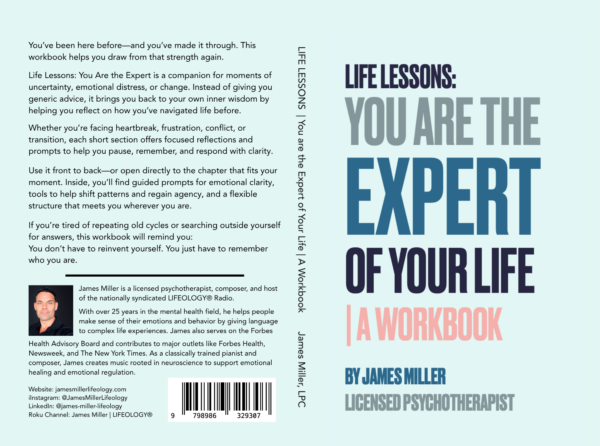
You’ve been here before—and you’ve made it through. This reflective workbook helps you draw on the lessons within your own experiences to recognize emotional patterns, respond to challenges with greater clarity, and move forward with intention.
You don’t need to reinvent yourself. You just need to remember what life has already taught you.